
Home / Morse Code Translator / Morse Code Sounder
FREE MORSE TOOL — NO SIGN-UPMorse Code Sounder: Hear Classic Telegraph Clicks
Classic Telegraph Sounder Simulator
Type any message, press play, and hear it exactly as a 19th-century telegraph operator would have heard it: a short click for every dot and a longer clack for every dash. Watch the letters light up as they play.
Morse code for your message:
Tip: start at 10 WPM and listen for the rhythm of each letter instead of counting dots and dashes. Real operators never counted — they recognised the sound of the whole letter, the way you recognise a whole word when someone speaks. Switch the sound to a modern beep tone if you prefer it, download your message as a WAV file to keep or share it, or switch on auto-play to hear each message as you type it.
Before Morse code lived in phone apps and radio beeps, it lived in clicks. A telegraph sounder was the little brass machine that turned electric pulses into sharp snaps an operator could read by ear, and for more than a hundred years it was the sound of the news, the railroads, and the outside world arriving.
1. What Is a Morse Code Sounder?
A Morse code sounder is a small electromechanical device that turns the on-off pulses of a telegraph line into sound. When current flows, a metal lever snaps down with a sharp click. When the current stops, a spring pulls the lever back up and it strikes a second stop with a duller clack. That is the whole machine, and it is also the whole secret of how Morse code was read for most of its history: not by watching a needle or a flashing light, but by listening.
Every dot in Morse code is a short burst of current, so it makes a quick click-clack. Every dash is a burst three times as long, so the gap between its click and its clack is three times wider. An operator sitting beside a sounder heard a stream of paired snaps and turned that rhythm straight into letters in their head. At full speed it sounds like a tiny wooden machine gun, yet trained ears could follow it at twenty words per minute or more, hour after hour, while carrying on a conversation at the same time.
The sounder was not the first Morse receiver. Samuel Morse first imagined a machine that would print dots and dashes on a strip of paper, and early telegraph offices really did use paper-tape registers. But paper was slow and reading it meant looking away from everything else. Operators soon discovered they could read the clicks of the register’s mechanism directly, without looking at the tape at all. The sounder was the result of cutting out the middleman: a device built purely to be listened to.
2. How a Sounder Works: Armature, Clicks, and Clacks
The working of a sounder comes down to four parts and one simple idea: electricity makes a magnet, the magnet pulls a lever, and the lever hitting its stops makes the sound. The electromagnet is a coil of wire around a soft iron core.
Above the magnet sits the armature, a flat bar of iron pivoted at one end like a tiny seesaw. A spring holds it up, away from the magnet, resting against the upper stop. When current flows, the magnet pulls the armature down.
This is why a sounder sounds so different from a buzzer or a beeper. A buzzer makes one continuous tone for as long as the key is down, and the operator hears the length of the tone. A sounder makes two short noises and the operator hears the space between them. A dot is a click and a clack close together. A dash is the same pair of noises with a longer silence in between. The spaces between letters and between words are longer silences still. Once you hear it that way, the code stops being a puzzle of dots and dashes and becomes a rhythm, and rhythm is something the human brain is very good at recognising.
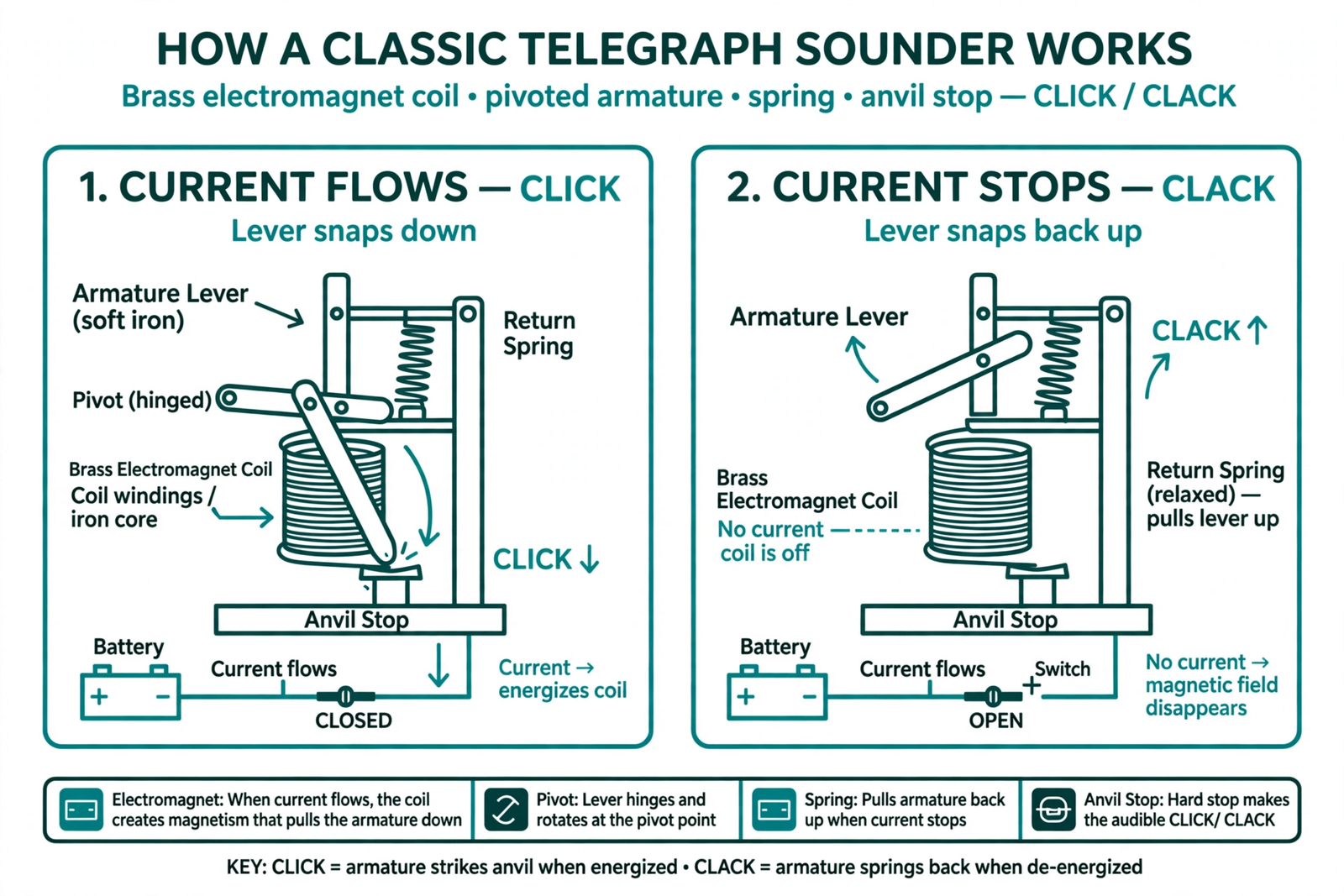
The parts of a classic sounder are few, and each one has exactly one job:
- Electromagnet: a coil of fine copper wire around an iron core. Current in makes it magnetic; current out makes it stop.
- Armature: the pivoted iron lever that the magnet pulls down. Its weight and shape set the tone of the click.
- Anvil: the lower stop the armature strikes on its way down. The click you hear is the armature hitting the anvil.
- Back stop: the upper stop the armature strikes on its way up. The clack is the armature hitting this stop.
- Spring: pulls the armature back up the moment the current stops, and sets how much force the magnet must overcome.
- Adjusting screws: let the operator set the travel of the lever and the tension of the spring, tuning the sound from a soft tap to a loud snap.
- Resonator box: the wooden base or box the sounder sits in, which amplifies the clicks so they carry across a room.
The sounder never works alone. It is wired in series with a telegraph key and a battery, and the key is simply a switch.
3. A Short History: From American Morse to the Railroad Telegraph
Morse code was born in the 1830s and 1840s, when Samuel Morse and Alfred Vail were building the first practical electric telegraph in the United States. Their original code, now called American Morse code, was different from the code we use today.
The sounder arrived because operators were faster than the machines built for them. The first American telegraph offices used a register that embossed dots and dashes onto a moving strip of paper.
The first sounders built for listening were little more than registers with the paper removed, but purpose-built sounders followed quickly, and by the 1860s they were standard equipment. The timing could hardly have been better.
The sounder’s golden age ran from the 1860s to the early 1900s. By then the telephone was taking over short-distance messages, and the typewriter was replacing the handwritten message form. But the sounder held on wherever reliability mattered more than novelty. Railroads kept them for decades, and the military kept them even longer. During both world wars, Morse code carried an enormous share of military traffic. The last commercial Morse circuits in America closed in the 1990s, and the last railroad telegraph offices fell silent not long after. What remains is the sound itself, preserved in museums, in amateur radio, and in simulators like the one on this page.
4. Sounder vs Buzzer vs Tone: What Is the Difference?
Beginners often mix up three devices that all make Morse code audible: the sounder, the buzzer, and the tone oscillator. They all do the same job — turn key presses into sound — but they sound different, they are built differently, and they teach your ear in different ways.
| Sounder | Buzzer | Tone oscillator | |
|---|---|---|---|
| Sound | Two mechanical clicks per element | One continuous buzz while the key is down | One pure musical tone while the key is down |
| What you measure | The silence between click and clack | The length of the buzz | The length of the tone |
| Era | 1840s–1990s, landlines | Early radio training sets | Modern radios and practice tools |
| Best for | Authentic history, ear rhythm | Cheap classroom practice | Clean listening, radio work |
| Weakness | Quiet, needs a resonator | Harsh, tiring sound | Feels nothing like the original |
A buzzer and a tone oscillator both play one sound per element; only the sounder plays two, and that second sound is the whole point.
The practical difference is what your ear learns to time. With a tone, you hear a beep start, continue, and stop. A dot is a short beep and a dash is a long beep, and the difference is obvious. With a sounder, you hear a click, a silence, and a clack. A dot is a short silence between two snaps; a dash is a longer silence. Your ear has to judge the gap, not the sound itself. That is harder at first, which is exactly why old operators said that learning on a sounder made you a better listener. Once you can read gaps, reading tones feels easy.
5. How Operators Read by Ear
Reading a sounder by ear looks like magic until you understand what the operator is actually doing, and then it looks like something you already know how to do. When you listen to speech, you do not hear individual letters and assemble them into words.
Every letter has a rhythm you can say out loud. The letter A, dot-dash, sounds like di-dah. The letter B, dash-dot-dot-dot, sounds like dah-di-di-dit. The letter S, three dots, is di-di-dit, and the letter O, three dashes, is dah-dah-dah. Operators learned these rhythms the way a drummer learns a beat, and at speed the rhythms blur together into the sound of the word itself. The word “the” is dah, di-di-dit, di — and an experienced operator heard that whole shape at once, without thinking about the three letters inside it.
- Click: the key went down, or the current started. Every element begins with a click.
- Short silence, then clack: a dot. The key was down for one unit of time.
- Longer silence, then clack: a dash. The key was down for three units of time.
- Short silence after a clack: the next element belongs to the same letter.
- Medium silence after a clack: the letter is finished, and a new letter is starting.
- Long silence after a clack: the word is finished. The next sound starts a new word.
The hardest part for a beginner is the silence. Silence feels like nothing is happening, and the beginner’s instinct is to panic and lose their place.
6. Morse Timing at Every Speed
All Morse timing comes from one number: the length of a dot. At any speed, a dash is three dots long, the gap inside a letter is one dot, the gap between letters is three dots, and the gap between words is seven dots. The standard formula is simple: one dot lasts 1,200 divided by the speed in words per minute, measured in milliseconds. At 20 words per minute, a dot lasts 60 milliseconds. At 5 words per minute, it lasts 240.
| Speed (WPM) | Dot (ms) | Dash (ms) | Letter gap (ms) | Word gap (ms) |
|---|---|---|---|---|
| 5 | 240 | 720 | 720 | 1,680 |
| 10 | 120 | 360 | 360 | 840 |
| 15 | 80 | 240 | 240 | 560 |
| 18 | 67 | 200 | 200 | 467 |
| 20 | 60 | 180 | 180 | 420 |
| 25 | 48 | 144 | 144 | 336 |
| 35 | 34 | 103 | 103 | 240 |
Dot length equals 1,200 divided by WPM. A dash is 3 dots, a letter gap is 3 dots, and a word gap is 7 dots.
7. Learning to Copy by Ear: A Simple Plan
You do not need a real sounder to learn to copy by ear. The simulator on this page is enough to start, and the plan below is the same shape as the training that railroad companies and the military used, stripped down to what actually works. The whole plan rests on one rule: learn the sound of each letter before you learn its dots and dashes. If you start by memorising dot-dash patterns from a chart, you will spend your time translating in your head, and translating is slow. If you start by listening, the letter becomes a sound, and sounds are fast.
- Week one, letters E, T, A, and N. These are the shortest and most common letters. Play them at 10 WPM until you can tell them apart without looking.
- Week two, add S, O, I, and M. Play short words made only from the letters you know: SOS, NO, MOM, TEN, EAT, SIT. Real words teach rhythm far better than random letters.
- Week three, add the rest of the alphabet in small groups. Learn R, L, and H, then D, B, and G, then the long letters J, Q, and Z last. Never add a new letter until the old ones are instant.
- Week four, add numbers. Numbers are all five elements long, so they are easy to recognise once you know the pattern: 1 starts with one dot, 2 with two, up to 5, which is all dots, then the pattern reverses with dashes.
- Daily practice, fifteen minutes. Short daily sessions beat one long weekend session. Five minutes of listening, five minutes of copying onto paper, and five minutes of sending.
- Raise the speed slowly. When you can copy a message at one speed without mistakes, move up by two words per minute. If mistakes return, drop back down. Speed is a result of accuracy, not a substitute for it.
- Copy real messages. Weather reports, station call signs, and short greetings are better practice than random letter drills, because your brain starts guessing the next word from sense, which is exactly what real operators did.
Try it now: set the simulator to 10 WPM, play SOS, and listen three times. Then close your eyes and play it again. If you can hear the three short clicks, the three long clacks, and the three short clicks as one shape, you have just copied your first word by ear.
8. The Full Morse Alphabet and Numbers
Here is the complete International Morse code for letters and numbers, as the simulator plays it. Letters are the working set of the code; numbers follow a beautifully regular pattern that makes them the easiest part to learn.
| Letter | Code | Letter | Code | Letter | Code | Letter | Code |
|---|---|---|---|---|---|---|---|
| A | .- | H | …. | O | — | V | …- |
| B | -… | I | .. | P | .–. | W | .– |
| C | -.-. | J | .— | Q | –.- | X | -..- |
| D | -.. | K | -.- | R | .-. | Y | -.– |
| E | . | L | .-.. | S | … | Z | –.. |
| F | ..-. | M | — | T | – | ||
| G | –. | N | -. | U | ..- |
| Number | Code | Number | Code | Number | Code | Number | Code | ||
|---|---|---|---|---|---|---|---|---|---|
| 0 | —– | 2 | ..— | 4 | ….- | 6 | -…. | 8 | —.. |
| 1 | .—- | 3 | …– | 5 | ….. | 7 | –… | 9 | —-. |
9. Building or Buying a Sounder Today
If the simulator has caught your interest, a real sounder is easier to find than you might think. Original sounders appear regularly at antique shops, radio flea markets, and online auctions, and many of them still work, because there is almost nothing in one that can break.
To run a real sounder you need three things besides the sounder itself: a telegraph key, a battery, and a little wire. A 6-volt lantern battery is enough for most sounders. Wire them in series — battery to key, key to sounder, sounder back to battery — and press the key.
One word of care is needed here, because old telegraph equipment sometimes ran on higher voltages than a modern battery. Some line sounders were built for circuits of 40 volts or more. Never connect a sounder, or any telegraph equipment, to a wall socket or to mains power. A battery is all you need, and it is all you should ever use.
10. Common Mistakes Beginners Make
Most beginners make the same few mistakes with a sounder, and all of them are easy to fix once you know what to listen for.
- Counting dots and dashes. Counting works at 5 words per minute and fails at 10. Learn the rhythm of each letter as one sound instead.
- Starting too fast. Speed feels like progress, but copying accurately at 10 words per minute teaches more than guessing at 20.
- Ignoring the silences. The gaps between letters and words carry as much information as the clicks. If you cannot hear a word gap, slow down until you can.
- Practising only with a tone. A tone is easier, so it hides weak listening. Spend some of every session on clicks, where the gaps do the work.
- Stopping after a mistake. One missed letter is nothing. Keep listening, leave a blank, and let the sense of the message fill it in.
- Only practising alone. Copying with a friend, or sending messages back and forth, keeps you honest and makes practice something you look forward to.
If you avoid those six mistakes and practise a little every day, the clicks stop sounding like noise within a few weeks. First you recognise SOS.
11. The American Morse Code the Sounder Was Built For
The sounder on this page plays International Morse code, the code used around the world today. But the original American sounders spoke a different code, now called American Morse code, and it was the code of the United States and Canada through most of the nineteenth century. Most letters were the same in both codes, and a listener who knew one could follow the other for a while. The differences were small, but they were exactly the kind of small differences that trip up a listener: a few letters were built differently, and a few letters contained a pause inside the letter itself.
The pause inside a letter was the hardest part. In American Morse, the letter C was two dots, a short pause, and then a dot. The letter O was a dot, a pause, and then a dot. The letter R was a dot, a pause, and then two dots. To a listener, the pause inside the letter sounded exactly like the pause between two letters, so the operator had to know from context which pauses were inside a letter and which were between letters. A beginner hearing dot, pause, dot could not tell whether it was the letter O or the two letters E and E. Experienced operators knew from the sense of the message, the way you know from sense whether a spoken sound is one word or two.
The second oddity was the long dash. In American Morse, the letter L was a single long dash, held about twice as long as an ordinary dash, and the numeral 0 was a long dash as well. The long dash gave the code a distinctive loping rhythm, and old operators could tell an American sender from a European one by ear alone. It also made the code harder to send cleanly, because a dash held a fraction too long could turn into an L by accident, and an L cut short could turn into a T.
By the early 1900s, American landline telegraph still used American Morse while radio used International Morse, and operators who worked both had to keep two codes in their heads. The landline code faded with the landline itself. The last commercial American Morse circuits closed in the 1990s, and International Morse is the code that survives in amateur radio, in aviation, and in simulators like the one on this page. The American code is gone from daily use, but its sound is preserved in old recordings, and anyone who listens to one hears at once how much of the original code was rhythm rather than pattern.
| Letter | American Morse | International Morse | What changed |
|---|---|---|---|
| A | .- | .- | Same in both codes |
| C | .. . | -.-. | American C had a pause inside the letter |
| E | . | . | Same in both codes |
| L | long dash | .-.. | American L was one long dash, not four elements |
| O | . . | — | American O was dot, pause, dot |
| R | . .. | .-. | American R had a pause inside the letter |
| S | … | … | Same in both codes |
| T | – | – | Same in both codes |
American Morse code, also called the Morse-Vail code, was used on American landlines from the 1840s until the 1990s.
Three things made American Morse harder to copy than the international code:
- Pauses inside letters. C, O, and R all contained a short silence in the middle, so the listener had to judge whether a gap was inside a letter or between letters.
- The long dash. L and 0 were both long dashes, and a dash held a moment too long or too short changed the letter entirely.
- Uneven spacing. Because some letters had internal pauses, the rhythm of a message was less regular, and a tired operator could lose the beat of a word.
12. Famous Morse Code Sounder Operators: Edison, Carnegie, and the Telegraph Boys
The telegraph office was the first place in America where a teenager could earn a grown wage with nothing but fast ears and a steady hand, and two of the most famous men of the age started there. Thomas Edison and Andrew Carnegie both learned their trade at a sounder, and both said the telegraph taught them how to think, how to listen, and how to work.
Edison learned Morse code as a boy and worked as a telegraph operator for Western Union and for the railroads, spending long nights as a night operator taking press reports off the wire. He went on to invent improvements to the telegraph itself: the duplex, which sent two messages over one wire at the same time, and the quadruplex, which sent four. The money from his telegraph inventions helped pay for his laboratory at Menlo Park, and the operator’s ear never left him. He judged his phonograph by listening to it, and he judged a machine by its sound as much as by its output.
Carnegie began at thirteen as a messenger boy for the Ohio Telegraph Company in Pittsburgh, carrying written messages between offices on foot. While he waited for replies he taught himself to read the sounder by ear, and he was soon promoted to operator for the Pennsylvania Railroad, where he took train orders off the wire. The railroad made him superintendent of its Pittsburgh division before he was twenty-five, and the telegraph habit of short, accurate messages stayed with him through his steel career, where a mistimed order could cost a fortune.
Thousands of boys like Carnegie worked as messengers and operators, and the telegraph was the first industry to hire large numbers of teenagers for skilled work. Operators developed a personal sending style called a fist, so distinctive that colleagues could recognise a sender by ear alone, the way you recognise a friend’s voice on the telephone. Some of the shorthand they used is still alive today, and radio amateurs still end their contacts with it.
| Signal | Meaning | Where it came from |
|---|---|---|
| 73 | Best regards | Phillips Code of 1879, the telegraph operator’s abbreviation book |
| 88 | Love and kisses | Phillips Code, used at the end of messages between friends |
| CQ | General call to all stations | A call to any station listening; still used by radio amateurs |
| OM | Old man, a fellow operator | Friendly telegraph slang for a colleague on the wire |
The Phillips Code, compiled by Walter P. Phillips in 1879, gave operators a book of number and letter shortcuts for common phrases.
The telegraph office taught its operators four things that no school taught as well:
- Accuracy under pressure. A train order copied wrong could send two trains onto the same track, so operators learned to check every word as they wrote it.
- Listening as a skill. An operator who could not hear the difference between a dot and a dash was useless, so listening was trained like a muscle.
- Short, clear messages. Every word cost money, so operators learned to say exactly what they meant in as few words as possible.
- The value of a fast ear. The quickest operators earned the best shifts, and speed came from practice, not from talent.
13. The Phillips Code: The Telegraph Operator’s Shorthand
Every word on a telegraph line cost money, so operators invented shortcuts. The most famous set was the Phillips Code, compiled by Walter P. Phillips in 1879, a book of number and letter abbreviations for the phrases operators used every day. A whole sentence could shrink to two characters, and a message that once took a minute to send took twenty seconds. The code spread to every telegraph office in America, and some of its shortcuts are still alive today in amateur radio.
Two of the Phillips Code entries are already on this page: 73, best regards, and 88, love and kisses, appear in the table of famous operators above. The table below gives the rest of the working set, the codes an operator reached for without thinking. They are short, they are practical, and they show how telegraph operators thought about language: not as words to be spelled, but as time to be saved.
| Code | Meaning | When operators used it |
|---|---|---|
| 1 | Wait a moment | Asking the other operator to hold on while you check something |
| 2 | Important, urgent message | Marking a message that must go through before ordinary traffic |
| 12 | Do you understand? | Checking that the other operator followed your message |
| 13 | I understand | Answering that the message was received and understood |
| 30 | End of message, no more | Closing a message or a news story, still used by journalists today |
| 92 | Deliver promptly | Marking a message that must be delivered at once, not with the ordinary mail |
| GA | Go ahead | Inviting the other station to send its message |
| GB | Good bye | The friendly farewell at the end of a contact |
| GM | Good morning | A greeting at the start of the day’s work |
| GN | Good night | A greeting at the end of the day’s work |
| TU | Thank you | Thanks for a message, a relay, or a favour |
| ES | And | The word and, shortened to two letters to save time |
| FB | Fine business | Very good, or well done, high praise from an operator |
| NR | Number | Placed before a message number so it is not confused with the text |
The Phillips Code was published in 1879 and was still in use in American telegraph offices a hundred years later.
Notice how practical the list is. There is no shortcut for a beautiful sunset or a clever idea, because telegraph offices did not send those. There are shortcuts for waiting, for understanding, for ending a message, and for saying thank you, because those are the things an operator needed a hundred times a day. The code was a tool for work, and it was shaped by the work, which is why it lasted so long after the telegraph itself was gone.
14. Morse Code Punctuation You Can Hear on a Sounder
Letters and numbers are the working set of the code, but a real telegraph message needed punctuation too. A train order without a full stop could be read two ways, and a price without a decimal point could cost a fortune. Operators learned the punctuation marks alongside the letters, and they sent them the same way, as rhythms of clicks and clacks, with the gaps doing the work of separating one mark from the next.
Punctuation codes are longer than letter codes, usually five or six elements, so they are the hardest marks to copy by ear. A full stop sent too fast sounds like a jumble, and a question mark sent without a clear gap after it can be misread as two letters. Slow down for punctuation, and leave a full letter gap after each mark. The table below gives the full international set, as the simulator on this page plays it.
| Mark | Morse code | When to use it |
|---|---|---|
| . (full stop) | •–•–•– | End of a sentence |
| , (comma) | ––••–– | A short pause inside a sentence |
| ? (question mark) | ••––•• | End of a question |
| ! (exclamation mark) | –•–•–– | Strong feeling, a warning, or an order |
| / (slash) | –••–• | Dates, fractions, and the word or |
| : (colon) | –––••• | Before a list or an explanation |
| ; (semicolon) | –•–•–• | Joining two closely related sentences |
| = (equals) | –•••– | Separating parts of a message; also the break signal |
| + (plus) | •–•–• | Also sent as AR, the end of a message |
| – (hyphen) | –••••– | Joining words and splitting call signs |
| ‘ (apostrophe) | •––––• | Contractions and possession, as in DON’T |
| ” (quotation mark) | •–••–• | Quoting someone’s exact words |
| @ (at sign) | •––•–• | Email addresses |
| ( ) (brackets) | –•––• / –•––•– | Extra information inside a message |
On a sounder, punctuation is recognised by its rhythm rather than its pattern. The full stop has a steady six-beat shape, the question mark rises and falls like a question in speech, and the comma has a loping rhythm all of its own. Listen to each mark three times on the simulator, then close your eyes and listen again. When you can tell a full stop from a comma without looking, your ear has learned the punctuation as sounds, which is the only way it will ever be fast enough to use.
15. How a Telegraph Circuit Works: From Key to Sounder
A sounder never works alone. It is one part of a circuit, and the circuit is what turns a press of a key in one town into a click in another. The parts are few, and each one has exactly one job, which is why the telegraph was so reliable. There was almost nothing in it that could break, and what could break could be fixed with a screwdriver and a spare wire.
The circuit is a loop. Current leaves the battery, travels through the key, along the line wire to the far station, through the sounder, and back along the ground to the battery. Pressing the key closes the loop and the current flows; releasing the key opens the loop and the current stops. The sounder at the far end clicks when the current starts and clacks when it stops, and that pair of sounds is the dot or the dash. The table below follows the current around the loop.
| Part | Job | What happens when you press the key |
|---|---|---|
| Battery | Provides the current | Current starts to flow around the loop |
| Telegraph key | The switch | Closing the key completes the circuit, opening it breaks it |
| Line wire | Carries the current | Current travels along the wire to the far station |
| Sounder | The receiver | The magnet pulls the armature down, and the operator hears a click |
| Ground return | Completes the loop | Current flows back through the earth to the battery |
| Relay | Boosts weak signals | A weak line current triggers a strong local circuit, so the sounder clicks loudly |
| Resonator box | Amplifies the sound | The wooden box makes the clicks loud enough to hear across a room |
On a long line, the current grew weak over the distance, which is why relays were used. A relay is a sensitive switch: a small current from the line pulls in a contact that closes a second, local circuit, with its own battery and its own sounder. The message was copied from line to line by relays, town to town, until it reached its destination, and each relay added a small delay that experienced operators could hear as a faint echo of the original sending. The system was slow by modern standards, and it was also almost impossible to stop, because every part of it was simple, visible, and repairable by hand.
16. Landmark Messages Sent by Sounder
The sounder carried the news of the nineteenth and twentieth centuries, one click at a time. Some of the messages it carried changed history, and some of them are famous because of the way they were sent, by hand, under pressure, with the whole world listening. The table below lists the ones that matter most, and each of them was sent by an operator sitting at a key, listening to a sounder, and writing down what they heard.
These messages are worth knowing because they show what the telegraph was for. It was not a toy, and it was not a hobby. It was the fastest way to move information across a continent, and the people who used it knew that a mistake could cost money, or a train, or a life. The care they took with the code is the reason the code survived them.
| Year | Message | Why it matters |
|---|---|---|
| 1844 | What hath God wrought | The first public telegraph message, sent from Washington to Baltimore by Samuel Morse |
| 1858 | First message across the Atlantic by cable | Queen Victoria’s greeting to President Buchanan, carried by the first transatlantic cable |
| 1861 | First transcontinental telegraph message | California was connected to the east coast, and the Pony Express ended overnight |
| 1906 | SOS adopted as the distress signal | Three dots, three dashes, three dots became the international call for help |
| 1912 | CQD and SOS from RMS Titanic | The Titanic’s operators tapped distress calls until the power failed, and the Carpathia came to the rescue |
| 1941 | News of Pearl Harbor by telegraph | Morse code carried the first reports of the attack across America faster than any other means |
| 1999 | The last commercial Morse message | Globe Wireless sent the final commercial Morse transmission, ending 155 years of the code in daily commercial use |
Every one of these messages was copied by ear from a sounder. The operators who received them did not see dots and dashes on a screen. They heard clicks and clacks, and they wrote down words. That is the skill the simulator on this page teaches, and it is the same skill, unchanged, that carried the first message in 1844 and the last one in 1999.
17. How to Care for an Old Sounder
An old sounder is a simple machine, and simple machines last a long time if they are treated well. Most sounders that survive today are more than a hundred years old, and many of them still work, because there is almost nothing in one that can wear out. A little care keeps them working for another hundred years, and a little neglect can silence one that survived a century of use.
The rules below are the ones collectors and museum curators follow. They are not complicated, and they all come back to the same idea: keep the machine dry, keep it clean, and never force it.
- Keep it dry. Moisture rusts the iron armature and the steel screws, and rust makes the lever stick. Store a sounder indoors, away from damp walls and basements.
- Clean the contacts with a pencil eraser. The contact points gather a thin layer of dirt that weakens the current. A soft eraser removes it without scratching the metal.
- Oil the pivot sparingly. One drop of light machine oil on the armature pivot, once a year, is enough. Too much oil gathers dust and gums up the movement.
- Do not over-tighten the spring. A spring wound too tight pulls the armature up too hard and makes the clack harsh. Adjust it until the click and the clack sound even.
- Store it upright. A sounder left on its side can bend the lever or strain the spring. Keep it flat on its base, the way it was designed to sit.
- Use a battery, never mains power. A 6 volt lantern battery is enough for most sounders. Never connect one to a wall socket, which would destroy it and could hurt you.
- Check the wiring insulation. Old cloth-covered wire can crack and expose bare copper. Replace damaged wire before you connect a battery.
- Keep the resonator box clean and dry. The wooden box is part of the sound. Dust it out gently, and keep it away from damp, so the wood does not swell and muffle the clicks.
If a sounder stops working, the fault is almost always one of three things: a dirty contact, a tired spring, or a broken wire. Check the contacts first, then the spring, then the wiring, and in most cases the machine will click again. That simplicity is the reason the sounder lasted so long, and it is the reason a machine built in 1890 can still teach a learner in 2026.
Frequently asked questions
Quick answers about the Morse code sounder, its sound, and its history.
What is a Morse code sounder?+
A Morse code sounder is a small electromechanical device that turns telegraph signals into sound. When current flows, an iron lever called the armature snaps down with a click; when the current stops, a spring pulls it back up with a clack. Operators read the message by listening to the pattern of clicks and clacks.
How is a sounder different from a buzzer?+
A buzzer makes one continuous sound for as long as the key is down, so you judge the length of the buzz. A sounder makes two sounds per element — a click when the key goes down and a clack when it comes up — so you judge the silence between them. A dot has a short silence between click and clack; a dash has a silence three times as long.
What does a dot sound like on a sounder?+
A dot sounds like a quick click-clack, with almost no gap between the two noises. A dash sounds like click, a clear pause, then clack. Once you hear the difference, you can tell dots from dashes without counting, because the rhythm of each letter becomes a single recognisable sound.
Why did railroad operators use sounders?+
Railroad stations needed a receiver that was cheap, tough, and easy to hear over the noise of a station. A sounder had no paper to replace, no ink to dry out, and no delicate parts. An operator could listen to it while writing down messages, and could recognise their own station’s call sign and even individual senders by ear.
Can I learn Morse code using only a sounder?+
Yes, and historically that is exactly how most operators learned. Start at 10 words per minute with the simulator on this page, learn the rhythm of each letter as one sound, and practise fifteen minutes a day. If you plan to use amateur radio later, add tone practice too, because radio Morse is heard as a tone rather than clicks.
How fast can a good operator copy from a sounder?+
Experienced operators commonly copied at 20 to 25 words per minute, and the best could reach 30 or more. At 20 words per minute, a dot lasts only 60 milliseconds, so nobody counts dots at that speed. Skilled operators heard whole letters and whole words as single sound patterns, the same way you hear whole words in speech.
Are real telegraph sounders still made today?+
Yes. Small workshops and amateur radio suppliers sell new reproduction sounders, and original sounders from the 1890s to the 1930s are easy to find at antique shops and radio flea markets. Many originals still work perfectly with a small battery and a telegraph key, because the design has almost nothing that can wear out.
What is the difference between American Morse code and International Morse code?+
American Morse code, used on United States landlines from the 1840s to the 1990s, had pauses inside some letters. The letter C was two dots, a pause, and a dot, and the letter O was a dot, a pause, and a dot. The letter L was a single long dash. International Morse code has no pauses inside letters and no long dash, which makes it easier to learn and to copy by ear, and it is the code that survives in amateur radio today.
Can I use a real sounder with a modern radio?+
Not directly. A sounder needs a direct current telegraph circuit, the kind a battery and a key make, while a radio sends Morse as a musical tone called a sidetone. To practise for radio, use a code practice oscillator or a straight key with a sidetone, which gives you the same timing as a sounder but in the tone you will actually hear on the air. A sounder is still the best tool for learning the rhythm of the code itself.
What is the Phillips code?+
The Phillips code is a book of shortcuts for telegraph operators, compiled by Walter P. Phillips in 1879. Instead of spelling out common phrases, operators sent a number or a short group of letters: 73 meant best regards, 88 meant love and kisses, and CQ was a general call to all stations. The table above lists the best-known Phillips code signals, and many of them, like 73 and CQ, are still used by radio amateurs today.
How loud is a real sounder, and can I make it quieter?+
A real sounder is loud enough to hear across a busy station, which was the whole point. If yours is too loud for home use, mount it on a piece of felt, keep it in a wooden box, or loosen the spring a little so the lever strikes more gently. The simulator on this page lets you choose between the classic clicks and a softer beep tone, so you can practise quietly and save the full click-clack for when you want it.
What power does a sounder need?+
A sounder needs only a small battery, usually three to six volts, wired in a simple circuit with a telegraph key. Current flows only while the key is held down, so the battery lasts a long time. Modern practice sets replace the battery and sounder with a code practice oscillator, which makes the same timing as a tone, but a battery, a key, and a sounder is still the simplest working telegraph you can build.
Conclusion
The sounder is how Morse code was first heard. Long before radio, operators sat at wooden desks and read the news, the train orders, and the weather from the clicks and clacks of a small iron lever. The rhythm they learned is the same rhythm you can learn on this page, and the simulator, the WAV download, and the practice tables give you everything a telegraph student had, without the battery and the wires.
Practise fifteen minutes a day at a steady speed, and listen to whole letters instead of counting clicks. When SOS and your own name feel automatic, try the telegraph key tool next, or take the same rhythm to the radio, where the clicks become a tone and the world answers back.
Keep listening to this morse code sounder, then try the morse code audio decoder and the morse code telegraph key — and read how the International Morse code standard defines every dot and dash.
Save this before your next message
You will likely need Morse code again — for a birthday card, a secret message, a puzzle, or a radio contact. The translator is free and always here.
Back to translator