
Home / Tools / Morse Code Telegraph Key
Morse Code Telegraph Key: Practise With a Telegraph Key
Morse Code Telegraph Key Practice Tool
Press and hold the key — or hold your spacebar — exactly like a real operator. A short press makes a dot, a long press makes a dash. Your keying is decoded live below the key.
A press under 220 ms counts as a dot — hold longer for a dash. On a keyboard, hold the spacebar instead of clicking.
Dot length = 1200 ÷ WPM. At 15 WPM one unit is 80 ms, so a dash is 240 ms and the gap between letters is 240 ms. Move the slider and watch the numbers change.
PRACTICE MODE — KEY THIS LETTER
Key K (-.-) with the key above.
GROUP PRACTICE — KEY THIS 5-LETTER GROUP
Key the letters one at a time, waiting for the letter gap between them.
A telegraph key is the oldest way to send Morse code — and still the best way to learn it properly. Use the free on-screen key above, then read the guide: grip, wrist, timing, the mistakes that slow beginners down, and how to pick your first real key.
Before radio had microphones, before keyboards, before touchscreens, there was a small brass lever on a wooden base — the telegraph key. Press it down and a circuit closes; let it spring back up and the circuit opens. Every dot and dash of Morse code is just a press of a different length, and every message ever sent by hand began with a finger on a knob exactly like the one in the tool above. To learn Morse code properly, your hand has to learn the rhythm.
Radio amateurs still send with straight keys every day, and the on-screen key on this page behaves like a real one. Ten minutes a day, and the key will stop feeling strange within a week.
What a Telegraph Key Actually Does
A straight key is a simple switch. It has a lever pivoted in the middle, a knob at one end for your fingers, and a pair of metal contacts at the other end. When you press the knob down, the contacts meet and current flows — that is your signal. When you release, a spring lifts the lever and the contacts separate — the signal stops. A dot is a short press, a dash is a press about three times as long, and the silences between them matter just as much as the presses.
That simplicity is the point. A key does not form letters for you, the way a keyboard does, and it does not correct your timing, the way a computer keyer does. It gives you exactly what your hand does — no more, no less. That is why teachers of Morse code have always started beginners on a straight key: it forces you to feel the timing instead of thinking about it. Other keys exist — a paddle key with an electronic keyer, and a bug with a vibrating pendulum — but the straight key is the one that teaches you the code itself.
The Straight Key: Grip, Wrist and Arm
Good keying starts before you press anything. Sit at a table with the key close enough that your forearm rests flat on the surface and your wrist floats just above the desk, level with the knob. The key should sit slightly to the right of your body if you are right-handed, so your arm comes at it straight rather than across your body.
Hold the knob lightly with the tips of your thumb and first two fingers, the way you would hold a small coin — thumb on one side, index and middle fingers on the other. You are pinching the knob, not squeezing it. If your knuckles go white, you are gripping too hard.
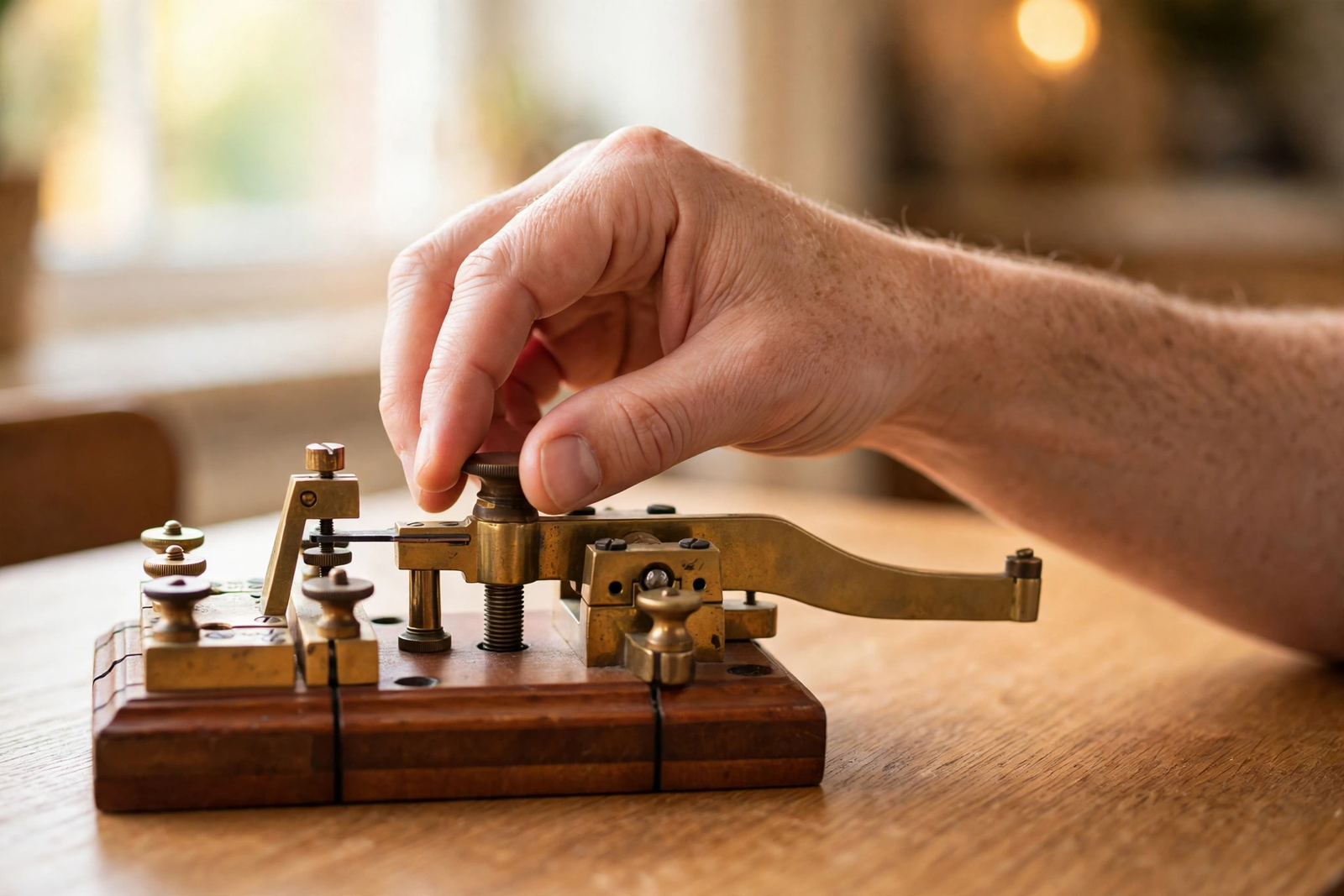
The movement comes from your wrist, not from your fingers and not from your whole arm. Keep your wrist straight and let it rock gently up and down, like a small hinge. Your forearm stays still on the table and acts as an anchor, and your fingers stay still too — they only hold the knob while the wrist does the work. When the motion is right, a dot is a tiny flick of the wrist down and back up, and a dash is the same movement held a fraction longer.
That wrist motion is the single most important physical skill in hand sending, and it is the one beginners get wrong most often. Sending with the fingers alone makes dots uneven and dashes ragged, because fingers are fast but imprecise. Sending with the whole arm makes everything heavy and slow, and your shoulder will ache within minutes. The wrist sits between the two: strong enough to be steady, light enough to be quick. Practise the motion on the on-screen key above until it feels automatic. Set the spring light and the contact gap small — a stiff spring fights your wrist, and a wide gap breaks your rhythm.
Timing and Spacing: The Five Numbers That Matter
Morse code is a timing code. The pattern of a letter tells you nothing on its own — what makes it readable is the exact length of each element and each silence. The international standard, set by the ITU, defines everything in units. One unit is the length of a dot. A dash is three units. The gap inside a letter is one unit, the gap between letters is three units, and the gap between words is seven units. Learn those five numbers and you have the whole timing system.
Speed is measured in words per minute, or WPM, using the standard word PARIS, which is exactly 50 units long. That gives a simple formula: one unit in milliseconds is 1200 divided by WPM. At 15 WPM, one unit is 80 milliseconds, so a dot lasts 80 ms, a dash lasts 240 ms, the gap between letters is 240 ms, and the gap between words is 560 ms. At 20 WPM, one unit is 60 ms.
| Element | Length | At 15 WPM | At 20 WPM |
|---|---|---|---|
| Dot | 1 unit | 80 ms | 60 ms |
| Dash | 3 units | 240 ms | 180 ms |
| Gap inside a letter | 1 unit | 80 ms | 60 ms |
| Gap between letters | 3 units | 240 ms | 180 ms |
| Gap between words | 7 units | 560 ms | 420 ms |
Beginners almost always get the gaps wrong before they get the dots and dashes wrong. The usual fault is running letters together: the gap between two letters shrinks to one unit, and the listener hears one long letter instead of two. The cure is to exaggerate the letter gap when you practise. Count it deliberately — dot, dot, dot, then a clear pause, then the next letter. A slow signal with clean gaps is readable; a fast signal with no gaps is noise. Dashes that are too short are the second fault: a dash must be three full units, so if yours feel long, they are probably right.
Your First Week With a Key
You do not need to learn all 26 letters before you start keying. The classic teaching order, called the Koch method, adds letters two at a time, so you are always sending real patterns instead of staring at a chart. Start with just two letters, K and M, and do not add a third until you can send and recognise those two without thinking. That sounds slow, and it is — but it works, because it builds the sound of each letter in your memory instead of the picture of it on a page.
Your first ten letters, in the order to learn them, are K, M, R, S, U, A, P, T, L and O. The Koch order starts with distinct patterns — K (-.-) and M (--) sound nothing alike — so your ear learns to tell patterns apart.
| Key | Who makes the dots | Who makes the dashes | Learning curve | Typical top speed |
|---|---|---|---|---|
| Straight key | Your hand, every element | Your hand, every element | Easy to start, hard to master | 20 to 25 WPM |
| Paddle and keyer | The keyer, perfectly timed | The keyer, perfectly timed | Moderate | 30 to 40 WPM |
| Bug (semi-automatic) | A vibrating pendulum | Your hand | Tricky to adjust | 25 to 35 WPM |
| Sideswiper | Your hand, side to side | Your hand, side to side | Unusual, few teachers | 15 to 20 WPM |
The table makes the trade clear. A straight key teaches you the code itself, because nothing hides your timing. A paddle lets you send faster and with less effort, but only after your timing is already clean. A bug is a piece of history that still works beautifully in skilled hands. The right order is almost always the same: learn on the straight key, move to a paddle when your code is clean at 15 WPM, and try a bug later for fun if the vintage style appeals to you.
How do you know you are ready for a paddle? Watch for these signs, and do not rush the move. A paddle hides bad timing, so moving too early only stores up trouble.
- Your straight-key code is clean and even at 15 WPM, with no ragged dots or short dashes.
- You can send a full minute of code without your hand getting tired or your wrist aching.
- Your letter gaps are steady at three units, and listeners never ask you to repeat a word.
- You recognise letters by sound, not by counting dots and dashes in your head.
- You have sent real messages, not just practice drills, and they were copied first time.
If two or three of those are not true yet, stay on the straight key a little longer. The paddle will still be there when you are ready, and it will feel easy when your timing is already right. Try the paddle mode in the tool above first: it uses two on-screen paddles, left for a dot and right for a dash, so you can feel the difference before you spend any money.
How Telegraph Schools Trained Operators
Long before anyone learned Morse code from an app, telegraph companies ran schools to train operators, and their methods still shape how the code is taught today. In the 1840s and 1850s, the first operators were trained by the railway companies, because the telegraph ran beside the railway tracks and the station agent was often the telegraph operator too. Training was practical from the first day: the student sat beside an experienced operator, copied real messages as they arrived, and practised sending on a spare key between trains. There was no classroom theory first. You learned by listening and by doing, which is still the fastest way.
By the early 1900s, commercial telegraph schools had appeared in most large towns. A student would enrol for three to six months, practise for several hours a day, and graduate when they could send and receive at 20 words per minute, the standard for a commercial operator. The schools taught American Morse code at first, which had different patterns from the international code used today, including dots inside letters, and students had to learn to hear the tiny gaps that separated them. When international Morse became the standard, the training got simpler, because every letter was a single pattern with no internal gaps.
The Second World War created the biggest training effort of all. The armed forces needed thousands of radio operators, and they trained them in weeks rather than months, with strict daily drills and constant testing. Women operators played a large part too, working in military signals units and in civilian telegraph offices, and many of them could send faster and more accurately than the men they replaced. The wartime schools discovered something that modern research has confirmed: short, frequent, focused sessions beat long, irregular ones, and learning the code by sound, rather than from a printed chart, produces operators who can copy at speed.
One of the most lasting ideas from that era is the Koch method, named after the German psychologist Ludwig Koch, who studied Morse learning in the 1930s. Koch found that students learned fastest when they started with just two letters at full speed, added a third only when the first two were automatic, and always practised at the target speed instead of starting slow. Starting slow feels kind, but it teaches your ear the wrong rhythm, and you have to relearn the sound of every letter later. The Koch order used in the tool above, K, M, R, S, U, A, P, T, L and O, follows exactly this idea: distinct patterns first, new letters added two at a time.
| Era | How operators were trained | Speed expected | What changed |
|---|---|---|---|
| 1840s to 1870s | Railway offices, learning beside an experienced operator | About 15 WPM | No formal schools; training was practical from day one |
| 1900s to 1920s | Commercial telegraph schools, three to six months | 20 WPM to graduate | American Morse gave way to international Morse |
| 1940s | Military signals training, weeks of daily drills | 20 to 25 WPM | Mass training; women operators in signals units |
| 1930s onwards | Koch method: two letters at full speed, add more slowly | Full speed from the start | Learning by sound replaced learning from charts |
| Today | Apps, on-screen keys and short daily sessions | 12 to 20 WPM for most amateurs | Anyone can practise anywhere, free |
The old schools also followed a daily drill that still works. It took about an hour, and every minute had a purpose. A modern version takes fifteen minutes, and you can do it with the tool on this page.
- Warm up (2 minutes): send even dots, then even dashes, with the wrist only, until the rhythm feels steady.
- New letters (5 minutes): practise the two newest letters in the Koch order until you can send them without thinking.
- Real words (5 minutes): send short words from the letters you know, like STOP, MARS, TOP and CATS.
- Listening (3 minutes): use the Hear it button in practice mode, listen to a letter, then key it back from memory.
- Review (2 minutes): write one line in your notebook, the date, the letters you know, and what felt better today.
That routine is more than a hundred years old, and it still works because it respects how the brain learns a rhythm: a little every day, always by ear, always at the real speed. The tools have changed, from brass keys on wooden bases to a key on your phone screen, but the method has not.
Key Maintenance: Cleaning Contacts and Adjusting the Spring
A telegraph key is a mechanical tool, and like any mechanical tool it needs a little care to keep working well. The good news is that maintenance takes minutes, costs almost nothing, and makes the difference between a key that feels smooth for years and one that starts to stutter after a few months. The two parts that need attention are the contacts and the spring.
The contacts are the two small metal discs that meet when you press the knob. Every press makes a tiny spark, and over time the spark leaves a dull film on the metal. A dirty contact does not close cleanly, so your dots come out broken or your key seems to miss presses. The spring sets how hard you must press, and it slowly weakens with use. A key that feels too light or too heavy is usually a spring that needs a quarter turn of its screw, not a new key.
| Task | How often | What to do |
|---|---|---|
| Clean the contacts | Once a month | Rub each contact lightly with a clean pencil eraser, then wipe with a dry cloth. Never use sandpaper, it scratches the metal. |
| Check the spring tension | Once a month | Press the knob and feel the resistance. If it feels too light or too stiff, turn the spring screw a quarter turn and test again. |
| Oil the pivot bearings | Every six months | One tiny drop of light machine oil on each pivot. Wipe away any extra oil at once. |
| Tighten the base screws | Every six months | Check every screw on the base and the lever. A loose screw lets the lever wobble sideways. |
| Polish the brass | Once a year | Use a soft cloth and a little brass polish. Keep polish away from the contacts. |
| Check the cable and plug | Once a year | Look for cracks in the insulation and a loose plug. Replace a damaged cable before it fails during a session. |
Keep these five things in a small box with the key, and maintenance becomes a two minute job instead of a chore.
- A clean pencil eraser, for the contacts.
- A soft dry cloth, for wiping dust and polish.
- A small screwdriver that fits the adjustment screws.
- Light machine oil, one drop at a time.
- A spare cable, so a damaged one never ends a practice session.
Do the monthly jobs on the first day of each month, and write the date on a small card kept with the key. A key that is cleaned and adjusted regularly will outlast its owner, and many of the brass keys sold today are already fifty years old and still sending clean code.
Numbers, Punctuation and Prosigns You Will Actually Use
The first ten letters of the Koch order will carry you through your first words, but real messages need more than letters. Numbers mark the time and the date, punctuation ends a sentence and asks a question, and prosigns are short signals that tell the other operator what is happening, such as the end of a message or the end of a contact. Learn these after your first ten letters, and your code becomes real communication instead of practice drills.
Numbers are the easiest to learn because they follow a strict pattern. The code for 1 is one dot and four dashes, the code for 2 is two dots and three dashes, and the pattern counts up to 5, which is five dots. After 5 the pattern flips, and 0 is five dashes. Punctuation is less tidy, so learn the four you will use most first: the full stop, the comma, the question mark and the slash.
| Number | Code | How to remember |
|---|---|---|
| 1 | •–––– | One dot, then four dashes |
| 2 | ••––– | Two dots, then three dashes |
| 3 | •••–– | Three dots, then two dashes |
| 4 | ••••– | Four dots, then one dash |
| 5 | ••••• | Five dots |
| 6 | –•••• | One dash, then four dots |
| 7 | ––••• | Two dashes, then three dots |
| 8 | –––•• | Three dashes, then two dots |
| 9 | ––––• | Four dashes, then one dot |
| 0 | ––––– | Five dashes |
| Mark | Code | Used for |
|---|---|---|
| Full stop | •–•–•– | End of a sentence |
| Comma | ––••–– | A short pause inside a sentence |
| Question mark | ••––•• | A question |
| Apostrophe | •––––• | An apostrophe, as in don’t |
| Exclamation mark | –•–•–– | An exclamation, for emphasis |
| Slash | –••–• | A slash, as in and/or or a date |
| Colon | –––••• | A colon, before a list or a time |
| Semicolon | –•–•–• | A semicolon, between two joined clauses |
| Equals sign | –•••– | A break, marking a new paragraph |
| Signal | Code | Meaning |
|---|---|---|
| AR | •–•–• | End of message |
| SK | •••–•– | End of contact, signing off |
| BT | –•••– | Break, a pause between parts of a message |
| KN | –•––• | Go ahead, I am listening to you specifically |
| AS | •–••• | Wait a moment, stand by |
Prosigns are sent as one continuous group, with no gap between the letters, which is what makes them different from ordinary letters. AR sounds like one flowing pattern, not like A followed by R. Practise them that way from the start, and they will feel natural when you hear them on the air.
American Morse Code vs International Morse Code
The Morse code you are learning is International Morse, the system the whole world agreed on in the 1850s. But the first American telegraph used a different code, American Morse, invented by Samuel Morse and Alfred Vail in the 1840s. The two codes share many letters, but eleven letters are different, and three of them use a trick that International Morse never uses: a gap inside the letter itself.
In American Morse, the letters C, O, R, Y and Z contain a short silence in the middle of the letter, and the letter L is a single dash held much longer than an ordinary dash. That made American Morse harder to learn, because the listener had to judge whether a silence was inside a letter or between two letters. When radio arrived, the problem got worse, because a fading signal could hide a silence entirely. The world moved to International Morse, where every letter is one solid pattern with no gaps inside it.
| Letter | International Morse | American Morse | What changed |
|---|---|---|---|
| C | –•–• | • • | Two dots with a gap inside, instead of dash dot dash dot |
| F | ••–• | •–• | Same pattern as international R |
| J | •––– | –•–• | Dash dot dash dot, instead of dot dash dash dash |
| L | •–•• | One long dash | A single dash held longer than T |
| O | ––– | • • | Two dots with a gap inside, instead of three dashes |
| P | •––• | ••••• | Five dots, instead of dot dash dash dot |
| Q | ––•– | ••–• | Same pattern as international F |
| R | •–• | • •• | Dot, gap, two dots |
| X | –••– | •–•• | Same pattern as international L |
| Y | –•–– | •• • | Two dots, gap, one dot |
| Z | ––•• | ••• • | Three dots, gap, one dot |
If you ever read an old American telegraph tape or a Civil War message, you are looking at American Morse, and the letters will not match the chart you know. The numbers differed too. But for sending and receiving today, International Morse is the only code that matters, and every operator on the air uses it.
Famous Telegraph Keys and Their Makers
A telegraph key is a simple tool, but the best ones are also beautiful objects, and a few makers became famous for getting the details right. Collectors still hunt for these keys today, and many of them are still in daily use, sending code a century after they were made.
The names below cover the whole story of the key, from the brass straight keys of the railway era to the precision paddles of the modern amateur. You do not need any of them to learn, but knowing them helps you recognise a good key when you see one at a radio rally or in a second-hand shop.
| Maker and key | Era | What it is known for |
|---|---|---|
| J.H. Bunnell straight key | 1880s | The classic American brass straight key, built for railway and commercial telegraph offices |
| Vibroplex Original Bug | 1904 | The first semi-automatic key, with a pendulum that makes the dots for you |
| Speed-X keys | 1930s | Affordable straight keys and bugs that put a good key within reach of every amateur |
| Bencher BY-1 paddle | 1970s | The paddle that made iambic keying popular with amateurs around the world |
| Kent keys | 1980s | Hand-made brass keys from England, known for smooth bearings and a heavy base |
| Begali keys | 1990s | Modern precision keys from Italy, machined to very fine tolerances |
A second-hand key from any of these makers is usually a better buy than a new cheap key, because the machining and the materials were better. Check the lever for sideways wobble, the contacts for corrosion, and the spring for a smooth adjustment, and a fifty-year-old key will send as cleanly as the day it was made.
Telegraph Keys in Amateur Radio Today
The commercial telegraph closed decades ago, but the key never went away. Amateur radio operators still send Morse code every day, and the straight key has a loyal following that grows every year. For many operators, the key is not nostalgia. It is the simplest, most reliable way to send, and it works when nothing else does.
If you learn the key, you can join a community that is active all year round. The events below are the easiest way in, and every one of them welcomes beginners.
- Straight Key Night, every 1 January, run by the ARRL, where operators put their paddles away and send only on straight keys for 24 hours.
- The Straight Key Century Club, a group of more than 20,000 members who collect contacts made with straight keys and bugs.
- QRP operating, where a small radio and a straight key fit in a jacket pocket and can reach across a continent on five watts.
- Parks and Summits on the Air, where operators carry a key to a hilltop or a park and send from a portable station.
- CW contests, where fast, accurate sending wins, and where the best operators still use a paddle or a bug.
- Field Day, every June, where clubs set up stations outdoors and the Morse tent is often the busiest one on the site.
| Event | When | What happens |
|---|---|---|
| Straight Key Night | 1 January | Operators send only on straight keys for 24 hours |
| SKCC Weekend Sprint | Monthly | A relaxed weekend event for straight key and bug users |
| CQ WW CW Contest | November | The biggest Morse contest in the world, with stations in every country |
| ARRL Field Day | June | Clubs operate outdoors for 24 hours, and Morse is often the busiest mode |
Start with Straight Key Night. It is slow, friendly, and full of operators who are happy to slow down for a beginner. Send your call sign, your name, and your town, and you will have made your first real contact on a key that is more than a hundred years old in design, and still the best way to learn.
Frequently Asked Questions
What is a telegraph key?+
A telegraph key is a simple hand switch used to send Morse code. Pressing the knob closes an electrical contact and makes a signal; releasing it stops the signal. A short press is a dot, a long press is a dash, and every letter is a pattern of dots and dashes.
How long should I press for a dot and a dash?+
A dash is three times as long as a dot. At 15 WPM, a dot is 80 ms and a dash is 240 ms, because one unit is 1200 divided by WPM. On this page, a press under 220 ms counts as a dot and a longer press counts as a dash, and the tool shows your exact press time.
Should I learn on a straight key or a paddle?+
Start on a straight key. It teaches you the timing of the code itself, because your hand makes every dot and dash. A paddle with an electronic keyer makes the timing for you, which feels easier but hides bad habits. Once your straight-key timing is clean, a paddle will feel natural.
Why does my sending sound uneven?+
Uneven code usually comes from sending with the fingers instead of the wrist, gripping the knob too hard, or rushing the gaps between letters. Loosen your grip, anchor your forearm on the desk, rock the wrist, and make the gap between letters a full three units.
How long does it take to learn to send Morse code?+
With fifteen minutes of daily practice, most people send their first ten letters cleanly within two to three weeks and hold a simple conversation at 10 to 12 WPM within two to three months. Short daily sessions beat occasional long ones.
Can I practise without a radio or a real key?+
Yes. The tool at the top of this page is a working telegraph key — press and hold it, or hold your spacebar, and it decodes your keying live. You can also use any cheap practice oscillator, which is a key plus a buzzer and needs no radio at all.
What speed should a beginner start at?+
Start at 12 to 15 WPM for sending practice, and do not raise the speed until your current speed feels easy and your code is clean. Raising the speed too early produces fast, unreadable code that is hard to unlearn.
What is the correct grip for a straight key?+
Pinch the knob lightly with the tips of your thumb and first two fingers, keep your wrist straight, rest your forearm flat on the desk, and move the key with a gentle rocking motion of the wrist — not with your fingers and not with your whole arm.
What is Straight Key Night?+
Straight Key Night is an annual on-air event, held around New Year, where operators make contacts using only a straight key. The pace is the operators are friendly, and beginners are welcome, which it the best first event for anyone who has just learned to send.
How do I adjust the gap and spring on my key?+
Set the contact gap to about the thickness postcard, then adjust the spring so the lever returns firmly needing a hard push. The contacts should close with a light touch open cleanly the moment you release the knob. If the key feels heavy the contacts stick, loosen the spring a little and try again.
What is iambic keying?+
Iambic keying is a paddle technique where one paddle sends dots and other sends dashes, and squeezing both at once makes the keyer alternate dot-dash-dot-dash for you. It lets you send faster hand movement, and it is the standard method for operators who use paddle and an electronic keyer.
Why do operators send CQ?+
CQ is a general call that means “I am calling any station”, and it comes the old telegraph practice of seeking a contact. An operator sends CQ followed by their call sign, then listens for anyone who answers. It the standard way to start a contact with a station you have not to meet.
Conclusion
A telegraph key is the oldest way to send Morse code, and still the best way to learn it. The straight key teaches your timing of the code itself, and once your timing is clean, else — paddles, keyers, faster speeds — follows naturally. little every day, keep your grip light and your wrist loose, and gaps between letters do as much work as the dots and dashes.
When you are ready, put the key on the air. A slow, friendly on Straight Key Night or any quiet evening is worth more than a practice sessions alone, because a real operator on the other end reason the key was invented in the first place.
Keep practising on this morse code telegraph key, then hear it on the morse code sounder and check the morse code alphabet chart — and read how the International Morse code standard defines every dot and dash.
Save this before your next message
You will likely need Morse code again — for a birthday card, a secret message, a puzzle, or a radio contact. The translator is free and always here.
Back to translator